
The legend
The King history forgot, and Touraine never left.
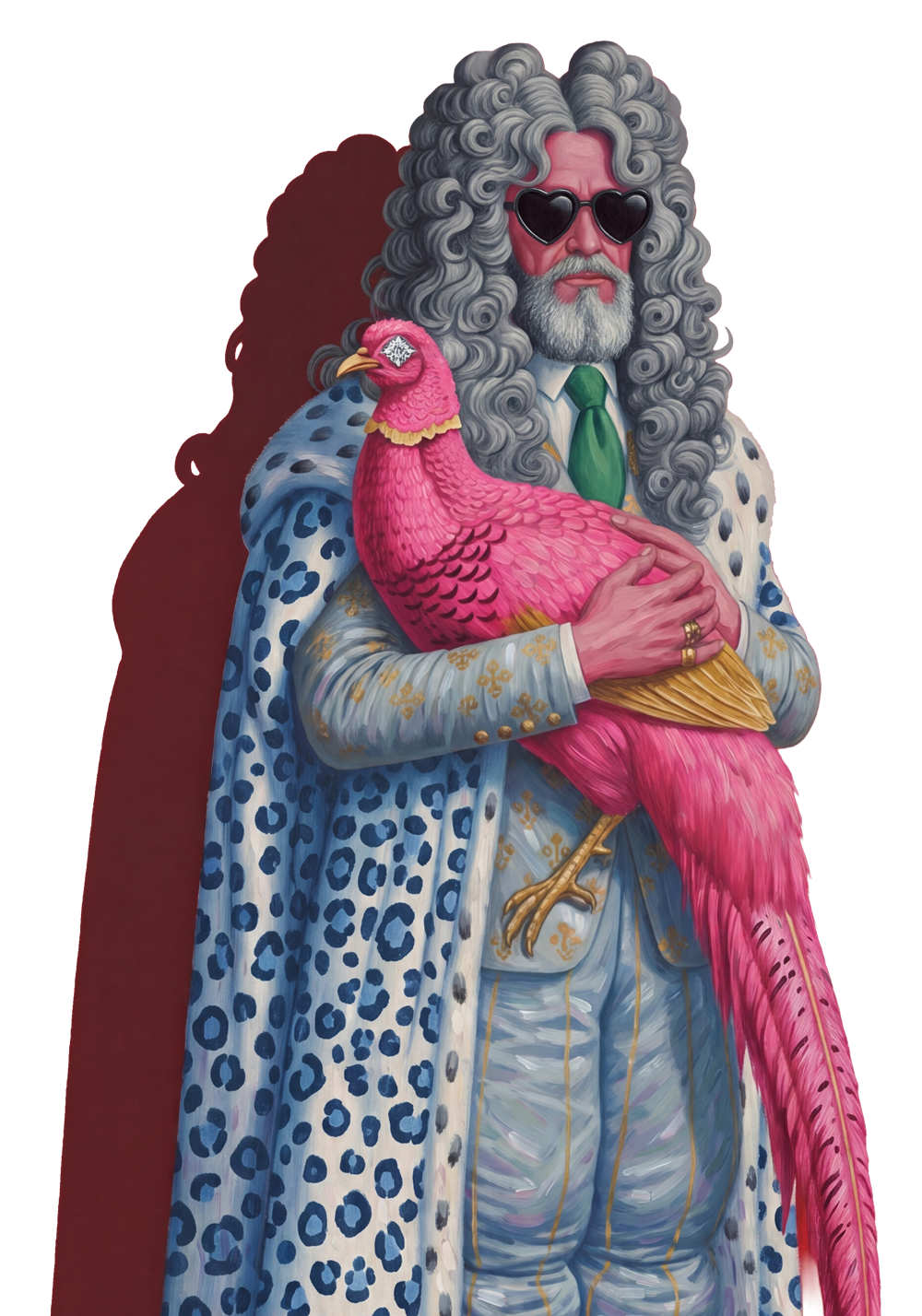
They say Louis 26, known as “The Strolling King”, was crowned in Amboise one harvest evening, his crown askew, a glass in one hand and a chicken leg in the other. His reign lasted the length of a ball. But unlike his predecessors, he never left it.
His decrees
Compulsory naps under the arbour, alarm clocks abolished, a table open at every reasonable hour. His Majesty never cared for war: he would rather receive guests. He has been feasting ever since, surrounded by his court of disguised geniuses.
Who lives in the kingdom?
Fifteen characters, each with a driving flaw. Swipe to meet them.
Swipe
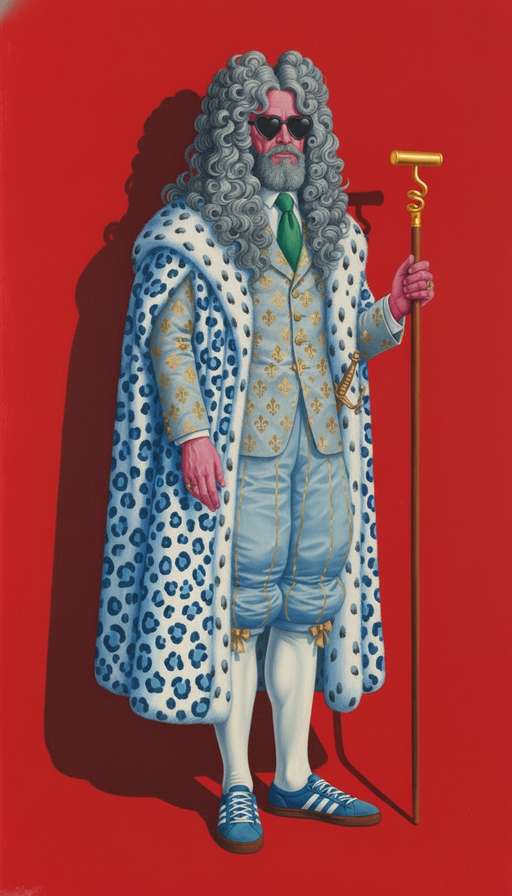
The Strolling King.
Any effort feels like a personal insult; he governs by absurd decrees from his hammock; dreams of officially moving morning to the afternoon.
It is said that he was once a man of action; the court historians are still searching for the proof. Each morning — which begins at two in the afternoon, by decree — he descends the staircase with a sovereign slowness, then governs from his hammock by edicts both absurd and tender.
The rare gift of the great idlers: to make the world better without ever seeming to take the trouble.

Sharp-witted wife who actually runs the kingdom.
Unable to delegate, she redoes everything behind everyone, three notebooks in hand, sighing just loud enough to be heard.
Louis 26 reigns from his hammock; Hortense reigns from everywhere at once. Three notebooks in her hands, a pencil in her hair, she redoes the accounts behind the steward, straightens the box hedges behind the gardener, crosses out the menus with a sigh just loud enough to be heard.
She is convinced the kingdom would stop dead if she set down a single notebook — no one has ever proven her wrong.

Procrastinating heir.
Refuses the throne until he has finished his game; negotiates absolutely everything for "five more minutes."
Everyone knows Eugène will be king one day. Everyone waits.
Eugène, for his part, negotiates: "five more minutes" is his currency, his sceptre, his universal argument. He has traded it for a welcome speech, a riding lesson, the coronation itself.
He does not flee his duties, he postpones them with a watchmaker's precision — to the point where one wonders whether he isn't, somewhere, perfectly right.
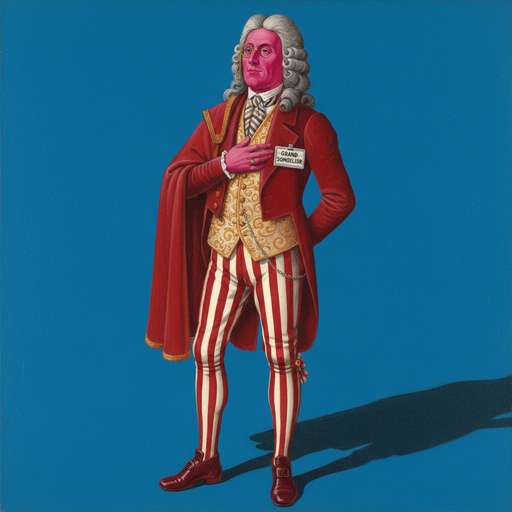
Vain Grand Sommelier.
He does not taste the wine, he tastes himself; physically incapable of resisting a compliment.
Master Florent de la Treille holds the most serious office in the kingdom — he says so himself, twice on Thursdays. When he raises a glass, the room holds its breath: not for the wine, but for the words that follow, always beautiful.
The day the cook praised his palate as "an instrument of rare precision," he drank nothing more, too moved. The only man to get drunk on a compliment before he has even opened the bottle.

Cunning steward of the vineyards.
Cannot help negotiating, even when everything is already won; every conversation ends in a transaction.
They say the Fox of the Treille has never lost a deal; they also say he has never managed to close one. Steward of the vineyards of Touraine, he has a price for every barrel, a clause for every plot.
When Louis 26 offered him the Clos Doré with no conditions, he bowed, then immediately proposed a discount in exchange for early delivery. Generosity bothers him like a badly hung door: he would negotiate the sun itself.

Mistress of the Stoves, slow and inflexible.
Her tempo is sacred; she would rather ruin a banquet than rush a cooking time, and NEVER changes a recipe.
At the court of Louis 26, the clocks obey Dame Berthe, not the other way around. The Mistress of the Stoves sets her timer, then waits; the fire waits too, for it has learned.
The day the king demanded his duck for noon, she answered without looking up: "The duck will be ready when the duck is ready." He took a nap, and he was right: the duck was sublime. She changes neither a recipe, nor her mind, nor her pace.

GRAND CONDUCTOR OF THE SERVICE (he DIRECTS the ballet of the service like an orchestra conductor — he NEVER carries the trays himself: the commis carry, he orchestrates).
Says yes to everything then improvises; conducts three services ahead with two memories behind.
At the court of Louis 26, meals do not arrive: they are conducted. Monsieur Hippolyte enters the great hall like an orderly storm — his baton rises, a commis pivots; it drops, three dishes head to the right.
He says yes to everything, then improvises: tonight he has promised the king quail first, quail third, perhaps quail fifth. The commis have learned to read his eyes rather than his mouth, which promises too much.

Brilliant, grumbling apprentice.
Everything outrages him, above all being proven wrong; he grumbles first, succeeds next, and refuses to admit the connection.
At the House of Stoves, you hear him before you see him: an indignant voice, the clatter of a spoon, and that is Joachim. He always has something to complain about — above all the advice he is given.
When the head cook suggests salt, he rolls his eyes, adds it grumbling, and the dish is perfect. He makes no connection.
The court calls him a genius disguised as a bad mood; he says the court understands nothing.

Candid, stubborn intern.
Cannot lie, even out of politeness; always asks THE question the whole court was carefully avoiding.
Apolline arrived one spring morning, tote bag on her shoulder, with the look of someone who has questions. She had many.
She asked Leonardo why his machines never really worked: he did not sleep for three days. She cannot lie — her face gives everything away before she opens her mouth.
At the Stoves, when Apolline frowns, you put down your utensils and sit down.

Mistress of Music, an artist.
Confuses budget with inspiration; any sum of money that passes by instantly becomes a party project.
Dame Clémentine the Bohemian is Mistress of Music to Louis 26. No one knows counterpoint better, nor the art of spending a royal coffer in forty-eight hours.
It all begins seriously: scores, lute, a precise idea. Then someone says the word "budget," and the party invents itself, before the ink is even dry.
The king has given up showing her the accounts: her parties alone are worth the trip.
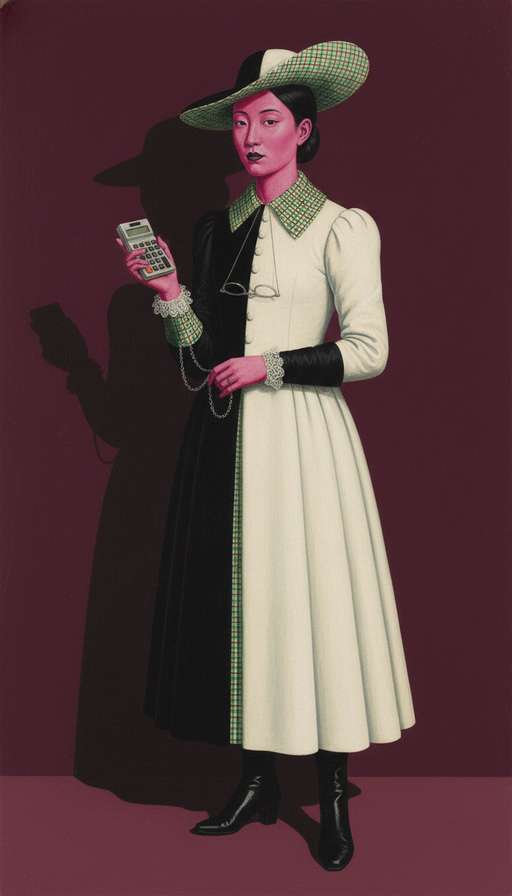
Grand Treasurer.
Counts EVERYTHING (the crowns, the minutes, the slices of tart, the thank-yous); one unbudgeted surprise makes her physically waver.
Dame Léonore always arrives early. Exactly seven minutes, neither eight nor six.
She is the one who knows what is left in the coffers of Louis 26: she notes everything, the loaves of bread, the king's nap hours, the slices of tart at the banquet. The day Alcofribas offered an unforeseen cake, she wavered — then opened a column for "unforeseen sweets," and the world became round again.
She does not refuse disorder; she finds it a line.
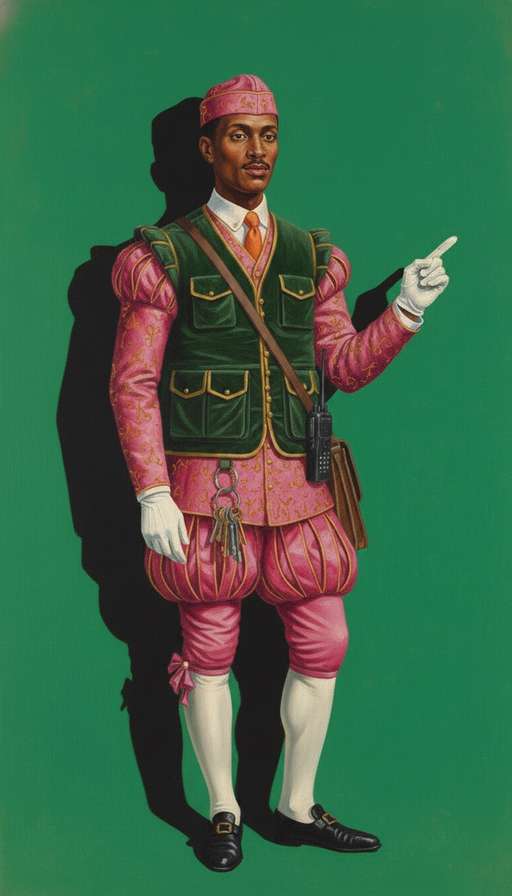
Omniscient head concierge.
Never says "I don't know"; rather than admit it, he invents a dubious shortcut or an approximate address.
At the castle of Louis 26, no one says "I don't know"; Master Côme has made it a vocation. Head concierge, his ring of keys jingling at every step, he always answers — quickly, with assurance, with a precise gesture toward an approximate direction.
When Leonardo went looking for walnut oil, he sent him toward a green door that did not exist: behind it, a broom closet and a sleeping cat. Leonardo came back with the cat; Côme nodded, satisfied.

Parisian visitor.
Compares everything to Paris, where it is necessarily "better"; wilts without an audience, even if just two gardeners.
Théodule landed at court one Tuesday morning, selfie stick raised like a banner. He greeted the king, the courtiers, then the two gardeners by the fountain: he needed an audience, any audience.
Paris, he announced in a carrying voice, did things differently. Better, he specified.
Louis 26 asked whether Paris also had Touraine plums. By evening, with three pages to show his pictures to, he declared the court "almost Parisian."
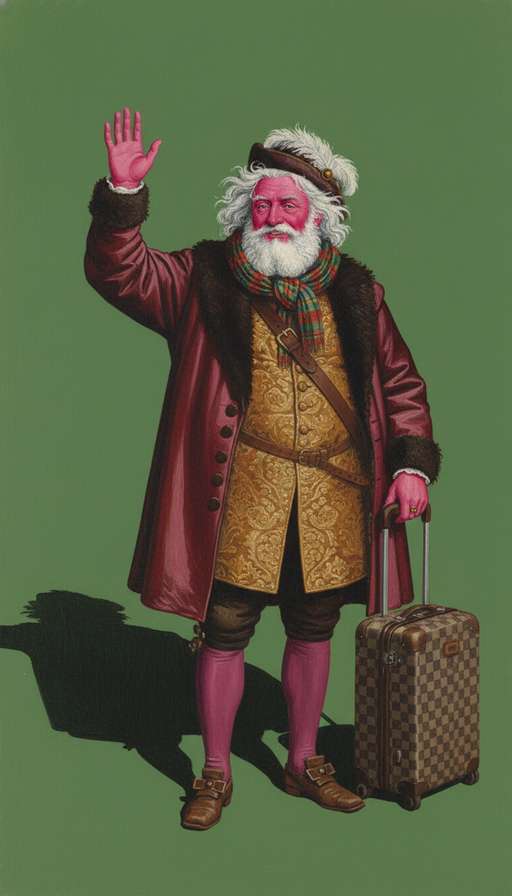
The King's neighbour and best friend.
Incapable of really leaving; his farewells last longer than his visits, and he always leaves "for the last time."
Count Anatole de Fontfroide is the most faithful neighbour of Louis 26; he is also the slowest to cross a doorway. His farewells began one Tuesday last year and are not yet finished.
He shakes the King's hand, lifts his rolling suitcase, then remembers something to say. Then something else.
His departure is a promise he renews every day, and keeps a little less well each time.
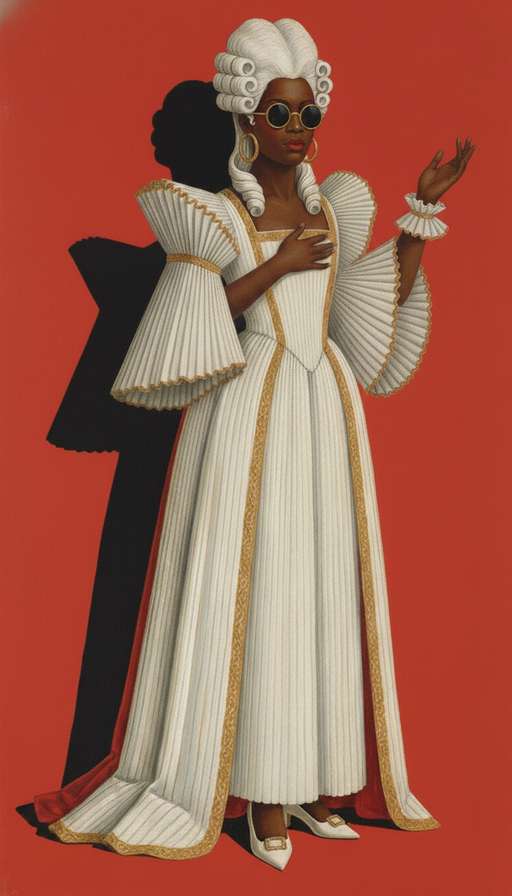
Noble neighbour.
Indignation is her favourite pastime; perpetually shocked but never absent, she always comes back to "check" what scandalises her.
The Marquise de la Saulaie does not live far: that is her misfortune, she says. She turns up at court two or three times a week, her hand already raised before she has crossed the bridge.
Something, always, shocks her: the king sleeps too much, Alcofribas eats standing up, the fountain makes an improper noise. She never leaves without having measured the full extent of the disaster — indignation made silhouette, going home each evening pleased with her work.
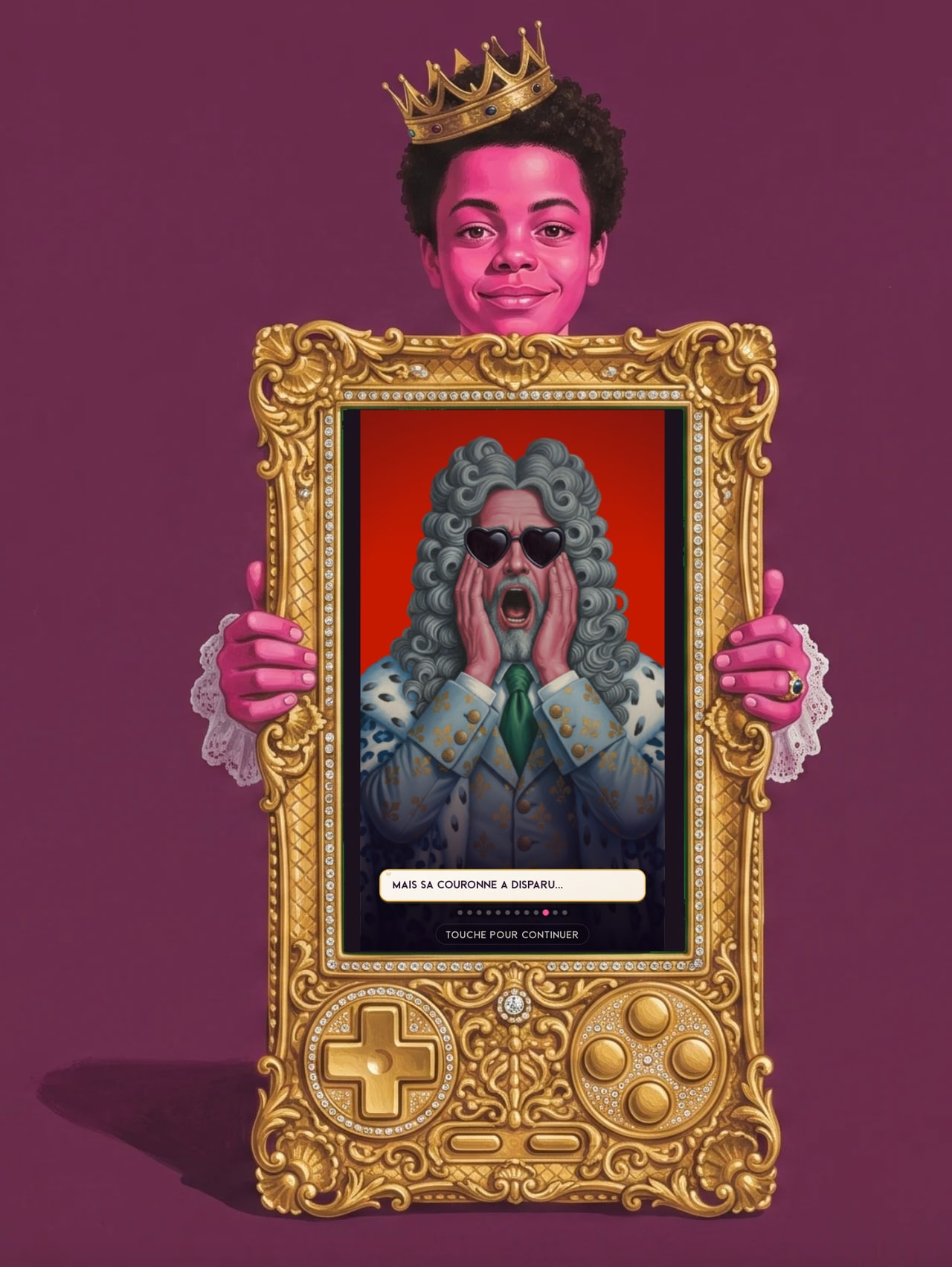
The game
A point-and-click crown hunt through the manor. Can you find the throne?
▶ Play